from 0 review
2 days
Daily Tour
Unlimited
English, Espanol, Francais, German, italian, polish, Romanian, russian
This 2 day trip to Luxor and Aswan with Abu Simbel from Cairo by flight covers three of Egypt’s most significant ancient sites in a single, tightly organized itinerary — Luxor’s East and West Bank temples, Aswan’s Nile-side monuments, and the colossal rock-cut temples at Abu Simbel — all connected by short domestic flights rather than long overland transfers. It’s built for travelers with limited time who still want to see the full sweep of Upper Egypt rather than choosing just one city.
You’ll fly from Cairo to Luxor early on day one, tour Luxor’s major sites with a private guide, then continue by road to Aswan for the night. Day two starts with an early visit to Abu Simbel before returning to Aswan for its own highlights and a flight back to Cairo that evening.
Covering Luxor, Aswan, and Abu Simbel in just two days is only realistic by flight, and this itinerary is built around that logic from the start — short domestic flights on both ends save the hours that an overland route between these cities would otherwise take, leaving more time for the temples themselves rather than the road.
The pacing also makes sense day by day: Luxor’s East and West Bank sites fill day one before an overnight in Aswan, and Abu Simbel is scheduled early on day two specifically to beat the desert heat, before the afternoon shifts to Aswan’s own highlights and a Nile felucca sail. With a private guide and vehicle throughout, and flights, hotel, and most meals arranged in advance, the logistics stay simple even with three major destinations packed into two days.
Pickup from your Cairo hotel is early, at 04:00, in a private air-conditioned car, heading to Cairo Airport for a flight to Luxor departing at 06:45 and arriving at 07:45. On arrival, your private guide meets you to begin the day.
The tour opens at Karnak Temple, widely regarded as the largest ancient religious site in the world — three main temples, plus smaller enclosed and outer temples, spread across 247 acres and built up over generations of pharaohs. From there, you'll visit Luxor Temple, built largely under Amenhotep III and Ramses II as the setting for the Opet Festival, a ritual meant to reconcile the pharaoh's human role with his divine office.
After lunch at a local restaurant, the tour continues to the West Bank. The Valley of the Kings holds tombs of rulers from the 18th to 20th Dynasty, including Ramses II and the young Tutankhamun, with much of the original decoration still remarkably well preserved. Nearby, Hatshepsut Temple is considered one of the most beautiful and best-preserved temples in ancient Egypt, built across three levels connected by broad ramps. The day's sightseeing finishes at the Colossi of Memnon, two massive statues of Amenhotep III carved from quartzite quarried near Cairo and transported some 700 km to Luxor.
From here, you'll continue by road to Aswan, where you'll spend the night.
The second day starts early with a private car ride from Aswan to Abu Simbel. The two temples here — dedicated to Ramses II and Queen Nefertari — were carved into the mountainside on the west bank of the Nile between 1284 and 1244 BC. The Great Temple, fronted by four colossal statues, was officially dedicated to Ra-Harakhty, Amun-Ra, and Ptah, though its real purpose was to glorify Ramses himself. The smaller temple beside it honors Queen Nefertari and the goddess Hathor. Both temples were later dismantled stone by stone and rebuilt on higher ground as part of a UNESCO relocation project, considered one of the organization's greatest preservation achievements.
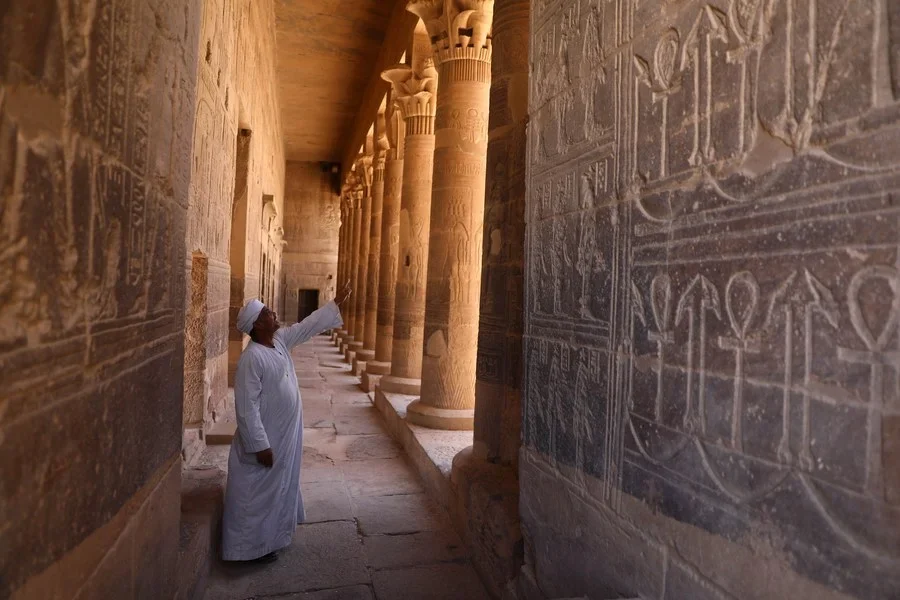
Back in Aswan by the afternoon, lunch is served before visiting Philae Temple, built to honor the goddess Isis and considered the last major temple constructed in the classical Egyptian architectural style. Next comes the Aswan High Dam, whose reservoir formed Lake Nasser, followed by the Unfinished Obelisk in the Northern Quarries — nearly 42 meters long and estimated at 1,168 tonnes, it cracked before completion and would have been the heaviest single piece of stone the ancient Egyptians ever worked.
At 16:00, you'll sail by felucca around Elephantine Island and visit Lord Kitchener's Island, with an optional two-hour stop at a Nubian village for travelers who'd like to add it. Your flight departs Aswan at 20:30, arriving back in Cairo at 22:00, where you'll be transferred to your hotel.
It's a 2-day, 1-night trip, with an overnight stay in Aswan between the Luxor and Abu Simbel portions.
Yes, you'll have a private guide and vehicle for both days.
Karnak Temple, Luxor Temple, the Valley of the Kings, Hatshepsut Temple, and the Colossi of Memnon.
The Great Temple of Ramesses II, with its four colossal statues, and the smaller temple dedicated to Queen Nefertari.
Philae Temple, the Aswan High Dam, the Unfinished Obelisk, and a felucca sail around Elephantine Island and Lord Kitchener's Island.
Yes, flights from Cairo to Luxor and from Aswan back to Cairo are included.
Yes, one night at the Basma Hotel in Aswan, on a bed and breakfast basis.
Lunch is included in both Luxor and Aswan, but dinner in Aswan is not included.
Yes, it's available as an optional add-on in Aswan.
Yes, a passport is required for the domestic flights.
The early departure is timed to reach the temples before the desert heat builds up later in the day.
Flights, a private air-conditioned car, entrance fees, your private guide, lunch in Luxor and Aswan, one night's hotel stay, and a motorboat trip to Philae Temple.
Tipping, dinner in Aswan, the felucca sail, and any extras not mentioned in the itinerary.
It involves two very early starts and a lot of ground covered across two days, so it suits travelers comfortable with an active schedule.
Yes, though the early departures and pace of the trip are worth considering for younger children.
A passport, camera, hat, sunglasses, and comfortable shoes for two days of temple visits.
Combining all three destinations into one 2-day flight-based itinerary is significantly more time-efficient than booking Luxor, Aswan, and Abu Simbel as separate trips from Cairo.

Member Since 2023