
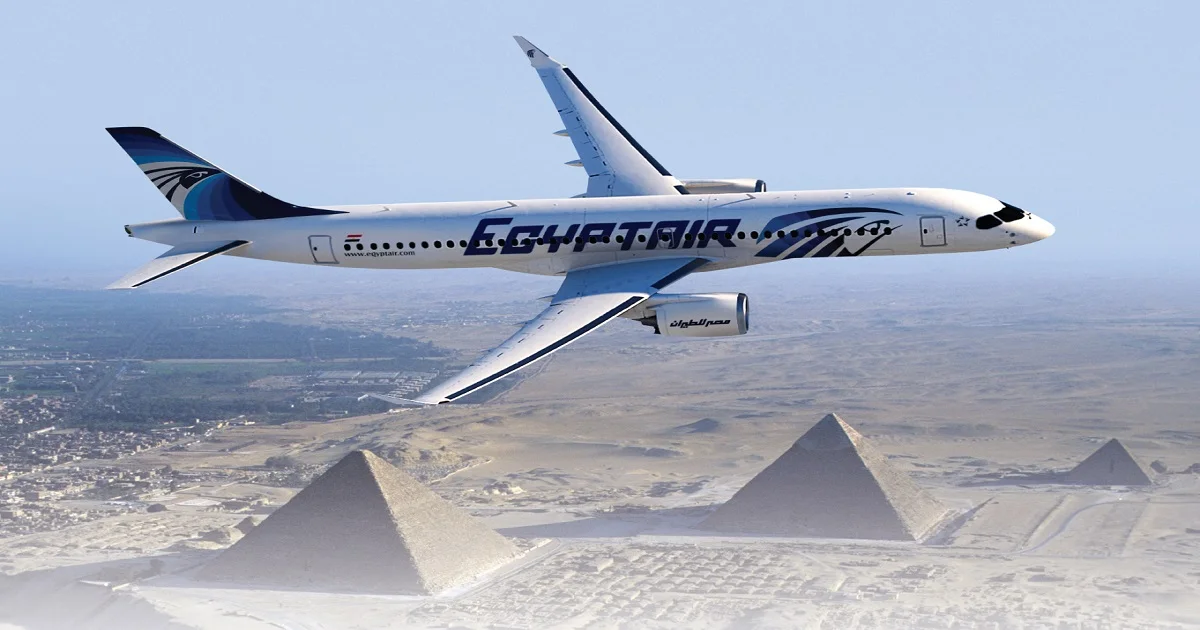

Few places on Earth capture the imagination like the Pyramids of Giza. Rising from the desert plateau on the outskirts of Cairo, these colossal structures have dominated the skyline for more than 4,500 years. They are not only the most famous monuments of ancient Egypt but also the last surviving Wonder of the Ancient World.
For travelers visiting Egypt, exploring the pyramids is often the highlight of the entire journey. But many visitors arrive with questions:
Can you go inside the pyramids?
What do they look like inside?
How much do tickets cost?
And what should you expect during your visit?
This complete guide will take you deep into the history, architecture, and visitor experience of the Giza pyramids. From the mysterious chambers hidden within the Great Pyramid to practical travel tips, everything you need to know is here.

The Giza Pyramid Complex: An Overview
The pyramids stand on the Giza Yaylası, about 9 kilometers from central Cairo. This archaeological area forms one of the most important historical sites in the world.
The complex contains several major monuments, including:
- The Pyramid of Khufu (the Great Pyramid)
- Khafre Piramidi
- Menkaure Piramidi
- Büyük Sfenks
- Mortuary temples
- Workers’ cemeteries
- Ancient causeways
- Remains of workers’ villages
Together, these monuments form what archaeologists call the Giza Necropolis, a vast funerary landscape built during Egypt’s Old Kingdom more than four millennia ago.
In 1979, the entire area – including nearby pyramid fields stretching toward Dahshur – was added to the UNESCO World Heritage List, recognizing its enormous cultural importance.

Why the Pyramids Were Built
The pyramids served as monumental tombs for powerful pharaohs of Egypt’s Fourth Dynasty. Ancient Egyptians believed that their rulers became divine after death and would continue their existence in the afterlife.
The pyramid structure symbolized a cosmic ladder helping the king ascend toward the heavens.
Each pyramid was part of a much larger sacred complex including:
- Mortuary temples for rituals
- Causeways connecting temples
- Boat pits for ceremonial solar boats
- Smaller pyramids for queens
- Cemeteries for nobles and officials
These complexes were designed to support the pharaoh’s eternal journey into the afterlife.
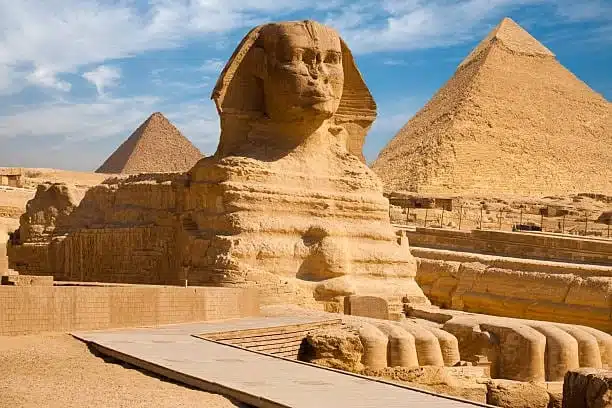
The Three Pyramids of Giza
Khufu'nun Büyük Piramidi
The Great Pyramid is the largest and most famous pyramid ever built in Egypt.
Originally it reached a height of 146.5 meters (481 feet), making it the tallest man-made structure on Earth for nearly 3,800 years.
Some incredible facts about the structure:
- Built around 2580–2560 BCE
- Constructed using about 2.3 million limestone blocks
- Blocks weigh between 2.5 and 15 tons
- Base width of 230 meters on each side
The pyramid was originally covered in smooth white limestone casing stones that reflected sunlight, giving the monument a brilliant appearance visible from great distances.
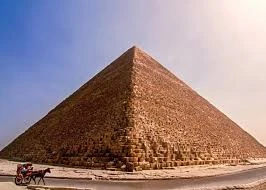
Khafre Piramidi
Khafre, the son of Khufu, built the second pyramid at Giza.
Although it is slightly smaller than the Great Pyramid, its higher ground placement makes it appear taller from a distance.
Notable features include:
- Remains of original limestone casing near the top
- The nearby Great Sphinx
- A sophisticated valley temple complex
Khafre’s pyramid complex is considered one of the best preserved from ancient Egypt.

Menkaure Piramidi
The third pyramid was constructed for Pharaoh Menkaure.
It is significantly smaller than the other two but contains unique architectural features.
Important details:
- Original height of about 65 meters
- Lower exterior faced with red granite from Aswan
- More complex mortuary temples
Menkaure’s pyramid marks a shift toward smaller royal pyramids later in Egyptian history.
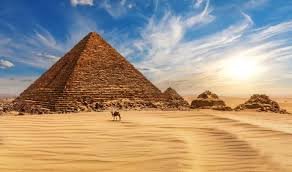
The Great Sphinx: Guardian of the Necropolis
Near the pyramids stands another iconic monument: the Great Sphinx of Giza.
This enormous limestone statue features the body of a lion and the head of a human, believed to represent Pharaoh Khafre.
Dimensions of the Sphinx:
- Length: 73 meters
- Height: 20 meters
The Sphinx symbolized royal power and divine protection. Positioned facing the rising sun, it served as the guardian of the sacred necropolis.

Can You Go Inside the Pyramids?
Yes, visitors can enter some of the pyramids at Giza.
However, access is limited and requires additional tickets. Not all chambers are open, and some pyramids occasionally close for restoration work.
Visitors are currently allowed to enter:
- Khufu'nun Büyük Piramidi
- Menkaure Piramidi
The Pyramid of Khafre is usually closed to the public except for special access visits.
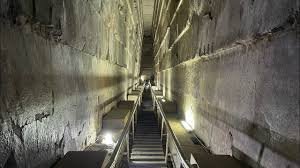
Inside the pyramids, visitors explore narrow corridors and chambers carved deep within the stone structure.
Ticket Prices and Opening Hours
The Giza Plateau operates daily with regulated visiting hours.
Typical visiting hours:
- Summer: 7:00 AM – 4:00 PM
- Winter: similar schedule with slight variations
- During Ramadan: opening starts later
Approximate ticket prices:
General entry to Giza Plateau
Adult: 700 EGP
Children: 350 EGP
Additional tickets:
Great Pyramid interior
Adult: 1500 EGP
Menkaure Pyramid
Adult: 280 EGP
Some tombs and archaeological areas also require separate tickets.
Tickets can be purchased on-site or online through Egypt’s official monument booking system.
What It’s Like Inside the Great Pyramid
Entering the Great Pyramid is a unique and unforgettable experience. However, visitors should know that the interior is not like a typical museum.
The passageways are:
- Narrow
- Steep
- Low ceilinged
- Sometimes warm and humid
Despite the challenging layout, exploring the interior offers a rare chance to experience one of the most extraordinary engineering achievements in human history.
The Grand Gallery
One of the most spectacular architectural features inside the Great Pyramid is the Grand Gallery.
This long ascending passage leads toward the King’s Chamber.
Important characteristics:
- Length of nearly 47 meters
- Height of about 8.5 meters
- Corbelled stone ceiling
- Steep inclined floor
The gallery’s design demonstrates remarkable architectural sophistication. Its massive stone blocks are carefully arranged to support the enormous weight of the pyramid above.
Scholars continue to debate the purpose of the Grand Gallery. Some believe it helped transport construction materials during building, while others suggest ceremonial or symbolic functions.
The King’s Chamber
At the heart of the pyramid lies the King’s Chamber, the burial chamber of Pharaoh Khufu.
The room is constructed entirely from massive granite blocks transported from quarries in Aswan, hundreds of kilometers away.
Key features include:
- Granite walls and ceiling
- Precise geometric proportions
- The famous granite sarcophagus
Interestingly, the sarcophagus is empty. No trace of Khufu’s mummy or burial treasures remains today.
Historians believe tomb robbers likely removed the contents thousands of years ago.
Above the chamber are five hidden relieving chambers designed to distribute the immense weight of the pyramid and prevent structural collapse.
The Queen’s Chamber
Located roughly halfway up the pyramid is the so-called Queen’s Chamber.
Despite its name, no evidence proves it was used for a queen’s burial.
Possible interpretations include:
- A symbolic chamber connected to religious rituals
- A space related to the king’s spiritual journey
- A design element within the pyramid’s internal structure
The room contains a distinctive niche in the eastern wall, which continues to puzzle archaeologists.
The Subterranean Chamber
Deep beneath the pyramid lies another mysterious space known as the Subterranean Chamber.
This chamber is carved directly into the natural bedrock beneath the pyramid.
Unlike the polished chambers above, this room appears unfinished, with rough walls and irregular surfaces.
Theories about its purpose include:
- An early abandoned burial chamber
- A symbolic underworld chamber
- A construction stage later replaced by the upper chambers
To this day, its true function remains uncertain.
The Pyramid’s Mysterious Shafts
Two narrow shafts extend from the King’s Chamber and two from the Queen’s Chamber.
Originally thought to be ventilation shafts, many researchers now believe they had a symbolic astronomical purpose.
These shafts align with important stars such as:
- Orion’s Belt
- Sirius
- Thuban
- Polaris
In ancient Egyptian belief, these stars were connected to divine realms and the afterlife. The shafts may have served as symbolic pathways for the king’s soul to reach the heavens.
Hidden Chambers and Modern Discoveries
Despite centuries of exploration, the Great Pyramid still holds secrets.
In 2017, scientists using muon scanning technology discovered a large unknown void above the Grand Gallery.
This mysterious space, often called the “Big Void,” remains inaccessible but could reveal new information about pyramid construction.
Advanced technologies such as:
- muography
- 3D scanning
- thermal imaging
are helping researchers investigate hidden spaces without damaging the ancient structure.
How the Pyramids Were Built
The construction of the pyramids required extraordinary planning and organization.
Evidence suggests:
- Etrafında 20,000–30,000 workers participated
- Construction lasted roughly 20 years
- Workers were skilled laborers, not slaves
Archaeologists have discovered workers’ villages, bakeries, workshops, and administrative buildings near the pyramids.
These discoveries show that pyramid building was a massive state-organized project supported by a sophisticated logistical system.
Visiting the Pyramids Today
Millions of visitors travel to Giza every year to see the pyramids.
When exploring the site, you can experience:
- Walking between the pyramids
- Entering selected chambers
- Visiting the Great Sphinx
- Riding camels across the desert plateau
- Viewing panoramic desert viewpoints
Guided tours with Egyptologists provide deeper insights into the complex history and symbolism of the monuments.
Tips for Visiting the Pyramids
To make the most of your visit, consider the following tips.
Arrive early
Morning visits offer cooler temperatures and fewer crowds.
Wear comfortable shoes
The terrain is sandy and uneven.
Bring water
The desert heat can be intense.
Protect yourself from the sun
A hat and sunscreen are essential.
Prepare for tight spaces
Inside the pyramids, passageways can be narrow and steep.
Myths and Legends About the Pyramids
Over the centuries, countless myths have surrounded the pyramids.
One famous story claims that Napoleon Bonaparte spent a night alone inside the Great Pyramid during his Egyptian campaign.
According to legend, he emerged deeply shaken but refused to reveal what he experienced.
Although fascinating, historians consider this story more myth than fact.
Another persistent legend involves hidden treasures buried deep inside the pyramids. In reality, most valuable artifacts were looted thousands of years ago.
Why the Pyramids Still Fascinate the World
Even after centuries of research, the pyramids continue to amaze scientists, historians, and travelers.
They represent:
- unmatched engineering skill
- profound religious symbolism
- extraordinary organizational power
Standing beside these massive monuments, visitors often feel a powerful connection to the ancient world.
Few human creations have endured so long or inspired so much wonder.
3. How Big Are the Pyramids of Giza?
Bu Great Pyramid of Giza, also known as the Pyramid of Khufu, is the largest and stands at 146.6 meters (481 feet) tall, although today it is slightly shorter due to the loss of its outer casing. It has a base length of 230 meters (755 feet) on each side.
- Dimensions of the Great Pyramid:
- Height: 146.6 meters (481 feet)
- Base: 230 meters (755 feet) per side
- Volume: About 2.5 million cubic meters
4. How Old is the Pyramid of Giza?
Bu Pyramid of Giza is about 4,500 years old. It was constructed during the Fourth Dynasty of the Old Kingdom of Egypt, around 2580 – 2560 BC.
5. How Were the Pyramids of Giza Constructed?
The construction of the pyramids has been a subject of debate for centuries. The general consensus is that they were built using limestone blocks that were quarried locally and transported to the site. Ramps, levers, and manpower were employed to lift and place the massive stones.
- Construction techniques:
- Ramps were used to move blocks up the sides of the pyramid
- Workers used levers and sledges to position the stones
- It is estimated that around 2.3 million stone blocks were used
6. When Was the Great Pyramid of Giza Built?
Bu Great Pyramid of Giza was built around 2580 BC. It took an estimated 20 years to complete.
7. Information About the Pyramids of Giza
Bu Giza Piramitleri are a group of three pyramids: the Khufu'nun Büyük Piramidi, bu Khafre Piramidi, ve Menkaure Piramidi. These are located on the outskirts of Kahire, Egypt.
- Other pyramids:
- Pyramid of Khufu (Cheops): Largest pyramid
- Khafre Piramidi (Sefren): Slightly smaller, with a still-visible casing on top
- Menkaure Piramidi: Smallest of the three
- Konum: Giza Plateau, Cairo, Egypt
8. When Were the Pyramids of Giza Built?
The construction of the pyramids occurred between 2580 BC ve 2500 BC. Each pyramid was built for a specific pharaoh during Egypt’s Old Kingdom.
9. Can You Go Inside the Pyramids of Giza?
Yes, visitors can enter certain chambers of the Great Pyramid and other pyramids on the Giza Plateau. However, the inside is limited to certain areas and may require an additional ticket.
- Chambers open to the public:
- King’s Chamber
- Queen’s Chamber
10. Did Aliens Build the Pyramids of Giza?
No, there is no scientific evidence to support the theory that aliens built the pyramids. The pyramids were constructed by skilled Egyptian workers using advanced techniques for the time.
11. Inside of the Great Pyramid of Giza
Bu Great Pyramid contains several internal chambers, including the King’s Chamber, bu Queen’s Chamber, and a series of passageways. The King’s Chamber houses a granite sarcophagus, which is believed to have held the pharaoh’s body.
- Key Chambers:
- King’s Chamber: Contained the pharaoh’s sarcophagus
- Queen’s Chamber: Function remains unclear
- Subterranean Chamber: Located below the pyramid
12. How Long Did the Pyramid of Giza Take to Build?
It is estimated that the Great Pyramid took about 20 years to complete. The construction was highly organized and required a large workforce.
13. How Tall Are the Great Pyramids of Giza?
Bu Great Pyramid of Giza oluyor 146.6 meters (481 feet) tall. The Khafre Piramidi stands at 143.5 meters (471 feet), while the Menkaure Piramidi oluyor 65 meters (213 feet) tall.
14. Who Built the Great Pyramid of Giza?
Bu Great Pyramid of Giza was built under the reign of Pharaoh Khufu (also known as Cheops). Thousands of workers, engineers, and architects were involved in the construction.
- Pharaoh Khufu: Builder of the Great Pyramid
- Architects: Hemiunu, the chief architect
15. Coordinates for the Great Pyramid of Giza
The exact location of the Great Pyramid of Giza is:
- Coordinates: 29.9792° N, 31.1342° E
16. What is Inside the Pyramid of Giza?
İçinde Great Pyramid, you will find the King’s Chamber, bu Queen’s Chamber, and numerous passageways. The most famous feature is the sarcophagus in the King’s Chamber, which is thought to have once contained Pharaoh Khufu’s remains.
17. Size of the Pyramids of Giza
Bu Great Pyramid has a base of 230 meters (755 feet) and a height of 146.6 meters (481 feet). Bu Khafre Piramidi ve Menkaure Piramidi are smaller in comparison.
18. Interesting Facts About the Great Pyramid of Giza
- It was the tallest man-made structure in the world for over 3,800 years.
- The pyramid is aligned with the stars of the Orion’s Belt.
- Bu Great Pyramid is made of 2.3 million stone blocks.
19. How Many Blocks Are in the Great Pyramid of Giza?
Bu Great Pyramid of Giza is constructed from approximately 2.3 million limestone blocks. Each block weighs between 2.5 to 15 tons.
20. How Many Sides Does the Great Pyramid of Giza Have?
Bu Great Pyramid has four sides. Each side is slightly concave, giving the pyramid its unique appearance.
21. Who Designed the Great Pyramid of Giza?
Bu Great Pyramid of Giza is traditionally attributed to the chief architect Hemiunu, who was a relative of Pharaoh Khufu.
22. Who Was Buried in the Great Pyramid of Giza?
Bu Great Pyramid was built as the tomb for Pharaoh Khufu (Cheops). However, his tomb has never been found, and some believe that his body may have been removed or lost.
23. Where Are the Pyramids of Giza?
Bu Giza Piramitleri are located just outside Kahire, Egypt. They are part of the Giza Necropolis, which includes other ancient tombs and structures.
24. How Many Stones Are in the Pyramid of Giza?
Bu Great Pyramid contains over 2.3 million stones. These stones, mainly limestone and granite, were transported from quarries and placed with precision.
25. Why Did They Build the Pyramids of Giza?
The pyramids were built to serve as tombs for the pharaohs. They were designed to protect the king’s body and treasures for the afterlife.
26. Can You Enter the Great Pyramid of Giza?
Yes, tourists can enter the Great Pyramid of Giza, but they are restricted to certain

- 50'den fazla tekne turu ve Tarihi Geziler arasından seçim yapın Hurgada
The Pyramids and Egyptian Religion
The pyramids were not just tombs; they were also important religious symbols. They were believed to represent the pharaoh’s journey to the afterlife. The pyramids were believed to be a way for the pharaoh to reach the sun god, Ra.
The pyramids were also important for the Egyptian economy. They required a large workforce to build, and they provided employment for thousands of people. The pyramids were also a source of revenue for the Egyptian government. The pyramids are a reminder of the rich and complex culture of ancient Egypt. They are a testament to the ingenuity and engineering skills of the ancient Egyptians, and they are a source of wonder and fascination for people from all over the world.
Pyramid Construction Techniques
The construction of pyramids was an incredible feat of engineering and architectural skill. The ancient Egyptians developed innovative techniques to build these towering structures that still amaze us today. The process involved careful planning, precise measurements, and the use of advanced tools.
One of the key techniques utilized by the ancient Egyptians was the use of ramps. These ramps allowed the workers to transport heavy blocks of stone to the desired height. The ramps were built using a combination of mud bricks and logs, creating a sturdy structure that could support the weight of the stones.
Another technique employed by the Egyptians was the use of lever systems. These levers provided a mechanical advantage, allowing the workers to lift and move heavy stones with relative ease. The levers were often made from wood and were strategically placed to distribute the weight evenly.
Additionally, the Egyptians used a method known as “quarrying” to extract the stone needed for the construction of the pyramids. They would identify suitable quarries and then chisel away at the rock to create individual blocks. These blocks would then be transported to the building site using the aforementioned ramp and lever systems.
Pyramid Construction History
The construction of pyramids in ancient Egypt spans a long and fascinating history that provides insight into the beliefs and motivations of the ancient Egyptians. The earliest known pyramid dates back to the Third Dynasty, with King Djoser’s Step Pyramid being the first of its kind.
Over time, the design and construction techniques of the pyramids evolved. The Step Pyramid was followed by the True Pyramids, which featured smooth, sloping sides. The most famous of these is the Great Pyramid of Giza, built for Pharaoh Khufu.
The construction of pyramids continued throughout ancient Egyptian civilization, with each pharaoh aspiring to build a grander and more impressive structure than their predecessors. The pyramids served as tombs for the pharaohs, believed to be essential for their journey to the afterlife.
Despite the grandeur and magnificence of the pyramids, their construction was not without challenges. The massive size and weight of the stones required a tremendous amount of manpower and resources. However, the ancient Egyptians were able to overcome these obstacles, leaving behind a lasting legacy that continues to captivate people worldwide.
Cultural Significance of Pyramids
The pyramids held significant cultural and spiritual importance in ancient Egyptian society. They were more than just monumental structures; they were a reflection of the Egyptians’ deep-rooted beliefs and their connection to the divine.
For the ancient Egyptians, the pyramids symbolized the pharaoh’s ascent to the heavens, where they would join the gods and achieve immortality. The shape of the pyramid, with its sloping sides leading to a point, represented the sacred mound that arose from the watery chaos at the beginning of creation.
Furthermore, the construction of pyramids involved the entire community, from farmers to skilled craftsmen. It was a collective effort that fostered a sense of unity and purpose among the ancient Egyptians. The pyramids served as a physical representation of the power and authority of the pharaoh, reinforcing the social hierarchy and the divine right to rule.
Moreover, the pyramids were not only places of burial but also served as temples and religious complexes. They were the focal point of religious rituals and offerings dedicated to the pharaoh and the gods. The hieroglyphs and intricate carvings inside the pyramids provided a glimpse into the religious beliefs and mythologies of ancient Egypt.
The cultural significance of the pyramids extended beyond their construction. These monumental structures became symbols of Egyptian civilization and continue to inspire awe and fascination to this day. They stand as a testament to the incredible achievements of the ancient Egyptians and their deep spiritual connection to the divine.
The Great Pyramid of Giza: A Monument to Immortality
Beyond majestic tomb, the Great Pyramid of Giza stands as a powerful symbol of ancient Egyptian beliefs. Not just a resting place for Pharaoh Khufu, its towering form echoes profound themes of creation, rebirth, and the pharaoh’s divine connection to the cosmos.
Here’s a glimpse into its significance:
Mirroring the Primeval Mound: Its shape reflects the Egyptians’ creation myth, where life sprang from a primordial mound rising from the chaos. Each stone echoes the fertile earth, promising the pharaoh’s eternal renewal.
Solar Alignment and Rebirth: Aligned with the cardinal points and celestial bodies, the pyramid embodies the daily and annual cycles of the sun, representing the pharaoh’s rebirth alongside the sunrise.
Stairway to the Heavens: Passageways and chambers symbolize the journey the pharaoh’s soul takes through the underworld, culminating in ascension to the sun god’s realm.
Osiris and the Duat: The pyramid’s interior mirrors the Duat, the underworld where Osiris, the god of resurrection, resides. The pharaoh, identified with Osiris, seeks rejuvenation within these sacred spaces.
An Enduring Legacy: More than just a tomb, the Great Pyramid stands as a testament to the ingenuity and spiritual depth of ancient Egypt, inspiring awe and wonder for millennia.
The Great Pyramid: A Legacy Built in Stone and Time
Towering out of the desert sands, the Great Pyramid of Giza isn’t just a pile of stones. It’s a frozen poem, etched in limestone and granite, whispering tales of an ancient civilization’s dreams and beliefs. This magnificent monument isn’t simply a tomb; it’s a beacon of eternity, a testament to the pharaoh’s divinity, and a portal to the heavens.
More than a mausoleum, the Great Pyramid embodies a symphony of meaning
- Echoes of Creation: Its very shape – a colossal pyramid rising from the earth – mirrors the Egyptians’ creation myth, where life first sprouted from a primeval mound. Each block whispers of rebirth, promising the pharaoh a new dawn beyond the veil of death.
- Aligned with the Cosmos: Precisely oriented to the cardinal points and celestial bodies, the pyramid dances with the sun, moon, and stars. It becomes a sundial of eternity, mirroring the daily and annual cycles of the cosmos, ensuring the pharaoh’s rebirth alongside the rising sun.
- A Stairway to the Heavens: Ascending passages and chambers map the pharaoh’s soul’s journey through the underworld, a perilous path ultimately leading to the celestial realm. They become testaments to the pharaoh’s divine lineage, granting him access to the realm of the gods.
- Osiris and the Duat: The pyramid’s interior echoes the Duat, the mysterious underworld where Osiris, the god of resurrection, dwells. Here, the pharaoh merges with Osiris, seeking rejuvenation and eternal life within these sacred chambers.
- A Whispering Echo: The Great Pyramid isn’t merely a relic of the past; it’s a living testament to the ingenuity and spiritual depth of ancient Egypt. Its whispers transcend time, inspiring awe and wonder even in the hearts of modern-day visitors.
The Great Pyramid is more than just stones stacked high; it’s a legacy in stone and time. It’s a testament to human ambition, a canvas painted with celestial dreams, and a portal to eternity.
This rephrased version retains the key themes of the previous one while incorporating some poetic elements and imagery to add depth and emotional resonance. It also emphasizes the enduring legacy of the Great Pyramid and its continued ability to inspire wonder and imagination.
Beyond Tomb: The Purpose and Symbolism of the Pyramids
While it’s true that the pyramids served as monumental tombs for the pharaohs, their purpose and symbolism extended far beyond simply housing the royal dead. They were, in essence, multifaceted testaments to ancient Egyptian beliefs and aspirations.
Here’s a closer look at the multifaceted purpose and symbolism behind the pyramids:
1. A Bridge to the Afterlife:
- Mirroring the Primeval Mound: The pyramid’s shape echoed the Egyptians’ creation myth, where life emerged from a primordial mound rising from the chaos. Each stone represented a fragment of this life-giving earth, promising the pharaoh’s eternal renewal.
- Stairway to the Heavens: Passageways and chambers symbolized the pharaoh’s soul’s journey through the underworld, ultimately leading to ascension to the sun god’s realm. The pyramid became a physical pathway to the celestial beyond.
- Union with Osiris: The interior spaces often mirrored the Duat, the underworld where Osiris, the god of resurrection, resided. The pharaoh, identified with Osiris, sought rejuvenation and eternal life within these sacred chambers.
2. A Symbol of Power and Divinity:
- Monumental Presence: The sheer size and complexity of the pyramids served as a tangible display of the pharaoh’s power and authority. They were physical manifestations of his divine status, connecting him to the gods and solidifying his position as a living god on Earth.
- Alignment with the Cosmos: The precise orientation of the pyramids – aligned with the cardinal points and celestial bodies – reinforced the pharaoh’s connection to the divine order. They became earthly reflections of the heavens, further solidifying his role as a mediator between the gods and mankind.
- Enduring Legacy: The pyramids were intended to withstand the test of time, serving as permanent testaments to the pharaoh’s reign and ensuring his memory and divine image lived on for eternity.
3. A Tool for Religious Ritual and Practice:
- Offerings and Rituals: Temples and mortuary complexes surrounding the pyramids served as venues for elaborate funerary rituals and offerings. These practices ensured the pharaoh’s continued well-being in the afterlife and maintained his connection to the living world.
- Astral Alignments: Certain pyramids were designed to align with specific celestial events, such as solstices or equinoxes. These alignments played a role in astronomical observations and religious ceremonies, connecting the earthly events to the grand cycles of the cosmos.
- Cosmic Power: The very act of constructing such massive structures was seen as a sacred undertaking, channeling the collective energy of the people and tapping into the divine power of the universe.
Unveiling the Nile’s Splendor: A Glimpse into Ancient Egyptian Civilization
Emerging from the lifeblood of the Nile River, ancient Egypt flourished for millennia, leaving behind a legacy etched in pyramids, hieroglyphs, and captivating myths. Understanding the background of this civilization is key to unlocking the secrets whispered by their monuments, like the majestic pyramids.
Cradle of the Nile:
Geography: Bounded by deserts, the Nile became the fertile artery of Mısır, nurturing life and shaping its culture. Annual floods deposited rich silt, enabling agriculture and laying the foundation for prosperity.
Dynastic Rule: For over 3,000 years, Egypt was governed by dynasties of pharaohs, considered divine intermediaries between gods and mankind. Their centralized rule fostered stability and monumental projects like the pyramids.
Polytheistic Beliefs: Egyptians worshipped a vibrant pantheon of gods like Osiris (god of the underworld), Ra (sun god), and Isis (goddess of magic). These deities permeated every aspect of life, from daily rituals to grand temples.\
Life on the Nile:
Social Hierarchy: A rigid social order placed the pharaoh at the apex, followed by nobles, priests, farmers, artisans, and slaves. Each played a vital role in the smooth functioning of the society.
Agriculture and Trade: The fertile Nile Valley and skilled farmers thrived on crops like wheat, barley, and flax. Trade flourished along the Nile and with neighboring regions, enriching the kingdom.
Arts and Crafts: Egyptians excelled in intricate mummification techniques, breathtaking art and architecture, and sophisticated writing systems like hieroglyphs. Their artistic legacy continues to mesmerize us.
Echoes in Stone:
Pyramids as Tombs: These monumental structures housed the pharaohs’ bodies, but their purpose extended far beyond. They were symbols of their divine status, pathways to the afterlife, and testaments to their earthly power.
Temples and Worship: Towering temples served as abodes for deities, adorned with hieroglyphs and vibrant murals. Priests performed elaborate rituals, ensuring cosmic balance and divine favor.
Mummies and the Afterlife: Egyptians believed in preserving the body for the soul’s journey in the afterlife. Mummification and elaborate tombs like the Valley of the Kings were central to their death rituals.
Ancient Egypt’s legacy transcends time, offering a captivating glimpse into human ingenuity, spiritual depth, and a society shaped by the life-giving Nile. Their pyramids stand as silent guardians, whispering tales of pharaohs, gods, and a civilization that continues to inspire and intrigue us.

Sonuç
The Pyramids of Giza are far more than ancient tombs. They are masterpieces of engineering, monuments to royal ambition, and symbols of a civilization that shaped human history.
From the hidden chambers inside the Great Pyramid to the silent gaze of the Great Sphinx, every corner of the Giza Plateau tells a story more than 4,500 years old.
Visiting the pyramids is not just a sightseeing experience. It is a journey into one of humanity’s greatest achievements.
And despite everything we have discovered so far, the pyramids still keep many of their secrets buried deep within the stone.
FAQ SEO (كل سؤال H3)
1
What are the Pyramids of Giza?
The Pyramids of Giza are ancient royal tombs built during Egypt’s Fourth Dynasty over 4,500 years ago for the pharaohs Khufu, Khafre, and Menkaure.
2
Where are the Pyramids of Giza located?
They are located on the Giza Plateau about 9 kilometers west of Cairo in Egypt.
3
How old are the Pyramids of Giza?
The pyramids were built around 2580–2500 BCE, making them over 4,500 years old.
4
Who built the Pyramids of Giza?
They were built for three pharaohs of the Fourth Dynasty: Khufu, Khafre, and Menkaure.
5
Why were the pyramids built?
The pyramids were built as royal tombs for pharaohs and were intended to help them reach the afterlife.
6
Can tourists go inside the pyramids?
Yes, visitors can enter the Great Pyramid and sometimes the Pyramid of Menkaure.
7
How much does it cost to visit the Pyramids of Giza?
General entry costs around 700 EGP, while entering the Great Pyramid requires an additional ticket.
8
What is inside the Great Pyramid?
Inside the Great Pyramid you will find corridors, the Grand Gallery, the King’s Chamber, and the Queen’s Chamber.
9
What is the Grand Gallery?
The Grand Gallery is a long ascending corridor leading to the King’s Chamber inside the Great Pyramid.
10
What is the King’s Chamber?
It is the main burial chamber inside the Great Pyramid where the granite sarcophagus of Pharaoh Khufu is located.
11
Is the sarcophagus inside the pyramid empty?
Yes, the sarcophagus is empty today because the tomb was looted thousands of years ago.
12
What is the Queen’s Chamber?
The Queen’s Chamber is a mysterious room inside the Great Pyramid whose exact purpose is still debated.
13
Are the pyramids aligned with stars?
Yes, many researchers believe parts of the pyramid align with important stars such as Orion and Sirius.
14
How tall was the Great Pyramid originally?
The Great Pyramid originally stood about 146.5 meters tall.
15
How many stones were used to build the Great Pyramid?
About 2.3 million limestone blocks were used.
16
How long did it take to build the pyramids?
The Great Pyramid likely took about 20 years to build.
17
Were slaves used to build the pyramids?
Archaeological evidence shows that skilled workers, not slaves, built the pyramids.
18
What is the Great Sphinx?
The Great Sphinx is a giant limestone statue with a lion’s body and a human head located near the pyramids.
19
Who built the Great Sphinx?
Most historians believe it was built during the reign of Pharaoh Khafre.
20
How big is the Great Sphinx?
It is about 73 meters long and 20 meters high.
21
When is the best time to visit the pyramids?
Early morning or late afternoon is the best time to visit due to cooler temperatures and fewer crowds.
22
What should I wear when visiting the pyramids?
Comfortable clothes, walking shoes, sunglasses, and sun protection are recommended.
23
Is it hot inside the pyramids?
The interior is usually cooler than outside but can feel warm due to limited airflow.
24
Are the pyramids part of UNESCO World Heritage?
Yes, the Giza Plateau was added to the UNESCO World Heritage list in 1979.
25
How far are the pyramids from Cairo?
They are about 9 km from downtown Cairo.
26
Can you take photos inside the pyramids?
Photography is sometimes restricted inside the pyramids.
27
Are guided tours available?
Yes, many guided tours with Egyptologists are available.
28
What is the Giza Plateau?
It is the desert plateau where the pyramids and the Sphinx are located.
29
How many pyramids are at Giza?
There are three main pyramids and several smaller ones.
30
Which pyramid is the largest?
The Great Pyramid of Khufu is the largest.
31
What materials were used to build the pyramids?
Mainly limestone, granite, and basalt.
32
Where did the granite come from?
Granite blocks were transported from Aswan.
33
What are pyramid shafts?
They are narrow passages leading from internal chambers toward the sky.
34
What is the Big Void in the pyramid?
It is a large hidden space discovered above the Grand Gallery in 2017.
35
Are new discoveries still being made?
Yes, scientists continue to study the pyramids using advanced technology.
36
Can you ride camels near the pyramids?
Yes, camel and horse rides are available around the Giza Plateau.
37
Is there a museum near the pyramids?
Yes, the Grand Egyptian Museum is located near the pyramids.
38
How many visitors come each year?
Millions of tourists visit the pyramids annually.
39
What civilization built the pyramids?
They were built by the ancient Egyptian civilization.
40
What dynasty built the pyramids?
The Fourth Dynasty of the Old Kingdom.
41
What is the purpose of pyramid shape?
It symbolized the rays of the sun and the king’s ascent to heaven.
42
How accurate are the pyramids’ alignments?
They are aligned with the cardinal directions with remarkable precision.
43
How heavy are the pyramid stones?
Most blocks weigh between 2.5 and 15 tons.
44
Can children visit the pyramids?
Yes, it is a family-friendly destination.
45
Are there restaurants near the pyramids?
Yes, several cafes and restaurants overlook the pyramids.
46
How long should you spend at the pyramids?
Most visitors spend between 2 and 4 hours exploring the site.
47
Can you visit the pyramids without a tour?
Yes, independent visits are allowed.
48
Are the pyramids safe for tourists?
Yes, the site is well protected and safe to visit.
49
Why are the pyramids so famous?
They represent one of the greatest architectural achievements in human history.
50
Why do the pyramids still attract researchers?
Because many mysteries about their construction and internal structure remain unsolved
 English
  German
  French
  Polish
  Russian
  Czech
Czech  Spanish
  Romanian
  Turkish
  Italian
  Hungarian
0 Comment