

Introduction: The Eternal Falcon Watching Over Civilization
Among all deities of ancient Egypt, few figures embody divine authority, cosmic balance, and royal legitimacy as powerfully as Horus Horus God of the Sky. Revered for over three millennia, Horus was not merely a god of the sky—he was the living symbol of kingship itself, the protector of order (Ma’at), and the eternal adversary of chaos embodied by Seth.
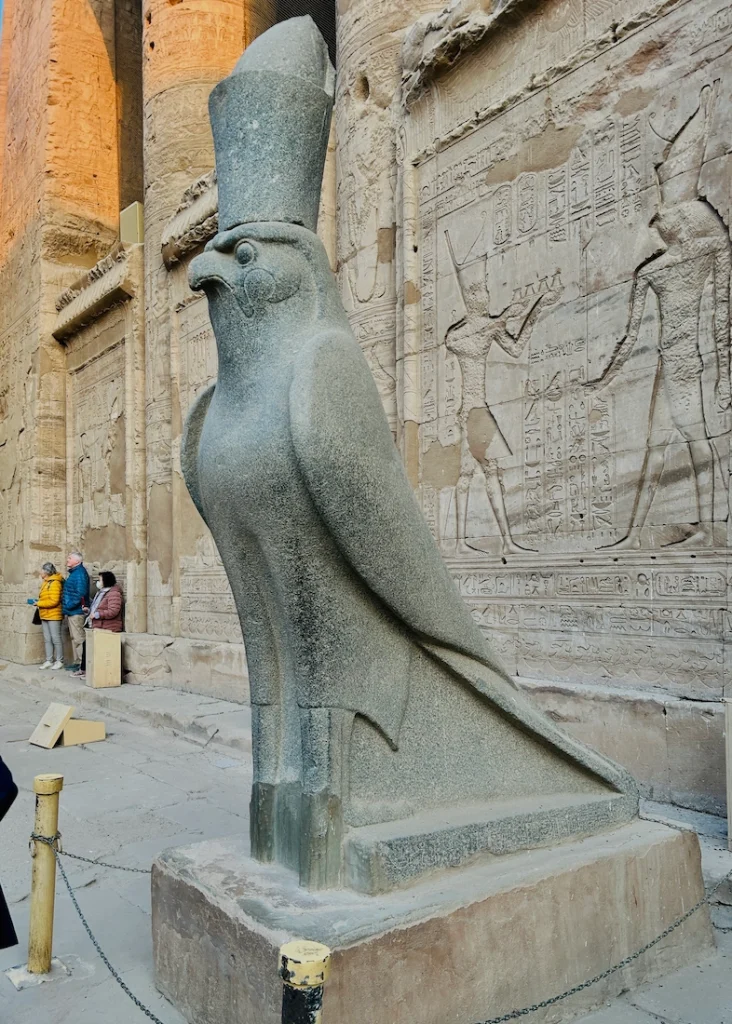
Depicted as a falcon soaring across the heavens or as a man with a falcon’s head crowned with the Double Crown of Egypt, Horus represented the unbreakable link between heaven and earth, god and king, myth and political reality.
His myth is not a simple story—it is the foundation of Egyptian civilization’s ideology of power.
Tour from Hurghada to Luxor 2-Day Trip with Hot Air Balloon Ride
Hurghada to Aswan & Abu Simbel Tour – 2 Days
Origins of Horus Horus God of the Sky: The Divine Child of Osiris and Isis
Horus was born from one of the most dramatic narratives in ancient mythology—the Osiris myth cycle.
After Osiris, king of Egypt, was murdered and dismembered by his brother Seth, his wife Isis secretly reassembled his body using divine magic. From this act of restoration, she conceived Horus.
Raised in the marshes of the Nile Delta, Horus grew hidden from Seth’s wrath, destined not only to avenge his father but to restore cosmic balance.
From his birth onward, Horus represented:
- Legitimate inheritance
- Divine justice
- The restoration of order after chaos
The Great Conflict: Horus vs Seth and the Birth of Justice
The central myth of Horus is his legendary struggle against Seth, a battle that lasted symbolically for eternity.
Key Episodes of the Myth
- Seth usurped the throne of Egypt after killing Osiris
- Horus challenged Seth to reclaim rightful kingship
- The gods formed a divine tribunal to judge their conflict
- A series of trials, battles, and transformations followed
Mythic Events of the War
- Horus lost his left eye in combat
- Seth was severely wounded and humiliated
- Thoth restored Horus’s eye through divine magic
- The Eye of Horus (Wedjat) became a symbol of healing and wholeness
Outcome
Horus was declared rightful ruler, establishing a cosmic principle:
Order (Ma’at) must always triumph over chaos (Isfet).
The Divine Pharaoh: Horus and Egyptian Kingship

No concept in Egyptian political theology is more important than the connection between Horus and the pharaoh.
Every king of Egypt was considered:
“The Living Horus”
This was not symbolic poetry—it was political doctrine.
Why Pharaohs Were Horus
- The king embodied divine authority on Earth
- Royal succession mirrored Horus’s inheritance of Osiris
- The throne represented cosmic stability
- Kingship maintained Ma’at, universal order
When a pharaoh died, he became Osiris; his successor became Horus. This created an eternal cycle of divine kingship.
The Sky Dominion: Horus as Cosmic Falcon
Horus was fundamentally a sky deity, often associated with:
- The sun (right eye)
- The moon (left eye)
- The horizon between worlds
- The flight of divine perception
His falcon form symbolized:
- Absolute vision
- Supreme control
- Spiritual elevation
- Protection from above
The Egyptians believed Horus’s gaze covered all of Egypt, ensuring no chaos could escape divine surveillance.
The Eye of Horus: The Most Powerful Symbol in Ancient Egypt
The Wedjat Eye is one of the most enduring symbols in human history.
Meaning of the Eye of Horus
- Healing and restoration
- Protection from evil forces
- Wholeness after injury
- Royal power and legitimacy
- Spiritual insight and clarity
Mythological Origin
The eye was torn apart during Horus’s battle with Seth and later restored by Thoth. Each piece represented mathematical fractions used in Egyptian medicine.
Use in Ancient Egypt
- Amulets for protection
- Jewelry worn by royalty and civilians
- Painted on boats for safe travel
- Placed on coffins for afterlife protection
Even today, it remains a global symbol of protection and awareness.
Temples of Horus: Sacred Centers of Divine Kingship
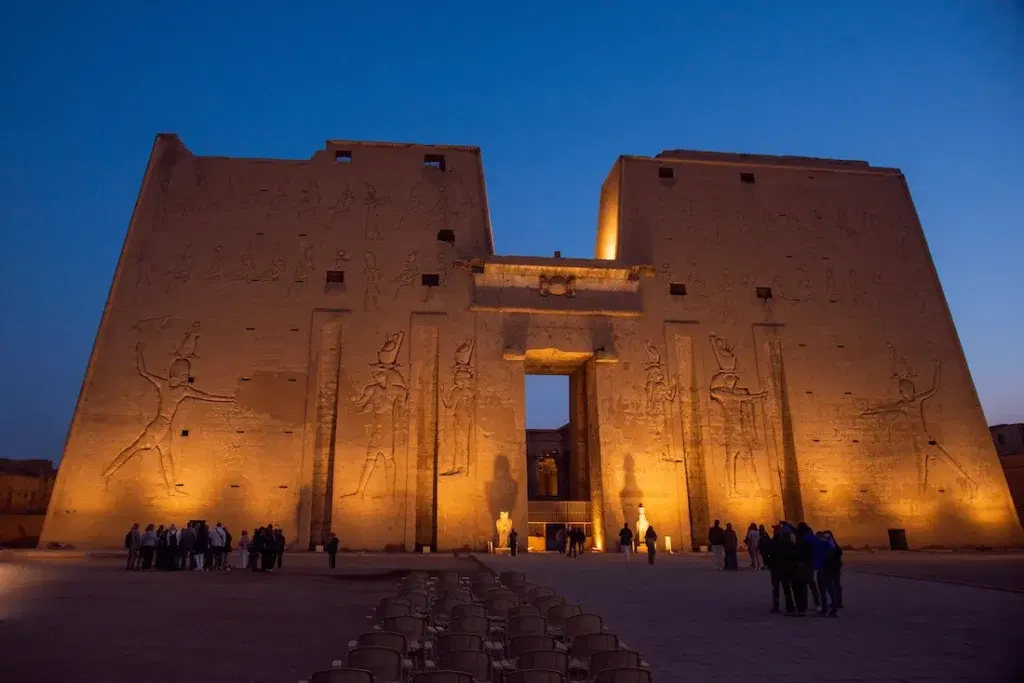
1. Temple of Horus at Edfu (Most Important Site)
The Temple of Edfu is the most complete and well-preserved temple in Egypt.
Built during the Ptolemaic period, it preserves the full myth of Horus in extraordinary detail.
Key Features:
- Massive pylon gateways
- Hypostyle halls with astronomical symbolism
- Sacred sanctuary of Horus
- Ritual chambers for priestly ceremonies
- Over 2,000 inscriptions of Horus mythology
This temple is not just architecture—it is a mythological archive carved in stone.
2. Kom Ombo Temple
A rare dual temple dedicated to:
- Horus the Elder
- Sobek, the crocodile god
It represents balance between:
- Sky and water
- Order and chaos
- Protection and danger
3. Nekhen (Hierakonpolis)
One of the oldest cult centers of Horus, predating dynastic Egypt itself.
Here, Horus was not myth—he was state ideology in formation.
4. Dendera and Child Horus Temples
Later periods worshipped Horus as Harpocrates, the divine child symbolizing:
- Renewal
- Silence
- Protected childhood
- Cyclical rebirth
Forms of Horus: The Many Faces of One God
Horus was not a single entity but a divine system of forms.
| Form | Role |
|---|---|
| Horus the Elder | Sky god and cosmic ruler |
| Horus son of Isis | Avenger of Osiris |
| Harpocrates | Child Horus, renewal and innocence |
| Horus of Behdet | Conqueror and unifier of Egypt |
| Ra-Horakhty | Fusion with the sun god Ra |
Each form reflects a different dimension of divine kingship.
Rituals and Worship of Horus
Daily Temple Rituals
Priests performed sacred ceremonies including:
- Purification of statues
- Offering food and incense
- Recitation of hymns
- Symbolic awakening of the god
Festival of Victory (Edfu Rituals)
A dramatic reenactment of Horus defeating Seth:
- Processions along the Nile
- Ritual battles symbolizing chaos vs order
- Coronation symbolism of kingship
- Restoration of cosmic balance
Protective Magic
The Eye of Horus was used in:
- Healing rituals
- Child protection
- Maritime safety
- Funerary protection
Symbolism of Horus in Egyptian Civilization
Horus represented the foundation of Egyptian ideology:
1. Political Power
The legitimacy of every ruler depended on Horus.
2. Cosmic Order
He ensured Ma’at remained dominant over chaos.
3. National Unity
His myth symbolized the unification of Upper and Lower Egypt.
4. Divine Justice
His victory over Seth represented eternal moral truth.
Rare and Lesser-Known Facts About Horus
- Horus appears in over 80 documented forms
- The Temple of Edfu contains one of the largest mythological inscriptions in Egypt
- The Eye of Horus influenced Egyptian mathematics and fractions
- Early dynastic kings used the “Horus Name” as their royal identity
- Some texts describe Horus as a cosmic falcon whose wings cover the Earth
Horus in Modern Culture
The legacy of Horus continues globally:
- Symbol in jewelry and tattoos
- Icon in films and video games
- Used in spiritual and metaphysical traditions
- Representation of protection and awareness
His Eye is now a universal emblem of insight and power.
Conclusion: The Eternal Guardian of Civilization
Horus is more than a mythological figure.
He is:
- The foundation of Egyptian kingship
- The defender of cosmic order
- The archetype of divine justice
- The eternal protector of civilization
Through his battle with Seth, Horus defined one of humanity’s oldest philosophical truths:
Order must be defended constantly against chaos.
❓ FAQs — Horus, God of the Sky
What is Horus the god of in ancient Egypt?
Horus is the ancient Egyptian god of the sky, kingship, protection, and divine justice. He represents the living authority of the pharaohs and the triumph of order over chaos.
Who are the parents of Horus?
Horus is the son of Osiris, god of the afterlife, and Isis, the goddess of magic and motherhood. His birth is part of the famous Osiris myth cycle.
What is the story of Horus and Seth?
Horus fought his uncle Seth after Seth killed Osiris and seized the throne of Egypt. After a long battle judged by the gods, Horus defeated Seth and became the rightful ruler of Egypt.
Why did Horus lose his eye?
Horus lost his eye during his battle with Seth. The eye was later restored by the god Thoth, becoming the famous Eye of Horus, a symbol of healing and protection.
What does the Eye of Horus mean?
The Eye of Horus represents protection, healing, wholeness, restoration, and royal power. Ancient Egyptians used it as an amulet for safety and spiritual protection.
Why was Horus important to pharaohs?
Pharaohs were considered the “living Horus” on Earth. This meant the king was believed to be the earthly embodiment of Horus, ensuring divine legitimacy and cosmic order.
Where was Horus worshipped in ancient Egypt?
Horus was worshipped in many places, especially in:
- Edfu (main temple of Horus)
- Nekhen (Hierakonpolis)
- Kom Ombo (shared with Sobek)
- Dendera (child Horus forms)
What animal represents Horus?
Horus is represented by a falcon, symbolizing vision, power, protection, and dominance over the sky.
What is the connection between Horus and Osiris?
Horus is the son of Osiris. After Osiris was killed by Seth, Horus avenged his father and restored order, becoming the rightful king of Egypt.
How many forms does Horus have?
Horus has many forms (over 80 in some traditions), including:
- Horus the Elder (sky god)
- Horus son of Isis (avenger)
- Harpocrates (child Horus)
- Ra-Horakhty (fusion with the sun god Ra)
Is the Eye of Horus still used today?
Yes. The Eye of Horus is still widely used in jewelry, tattoos, spiritual practices, and symbolism for protection and good health.
What does Horus symbolize overall?
Horus symbolizes:
- Kingship and leadership
- Protection and divine guardianship
- Justice and order (Ma’at)
- Victory over chaos and evil





























Comment (0)